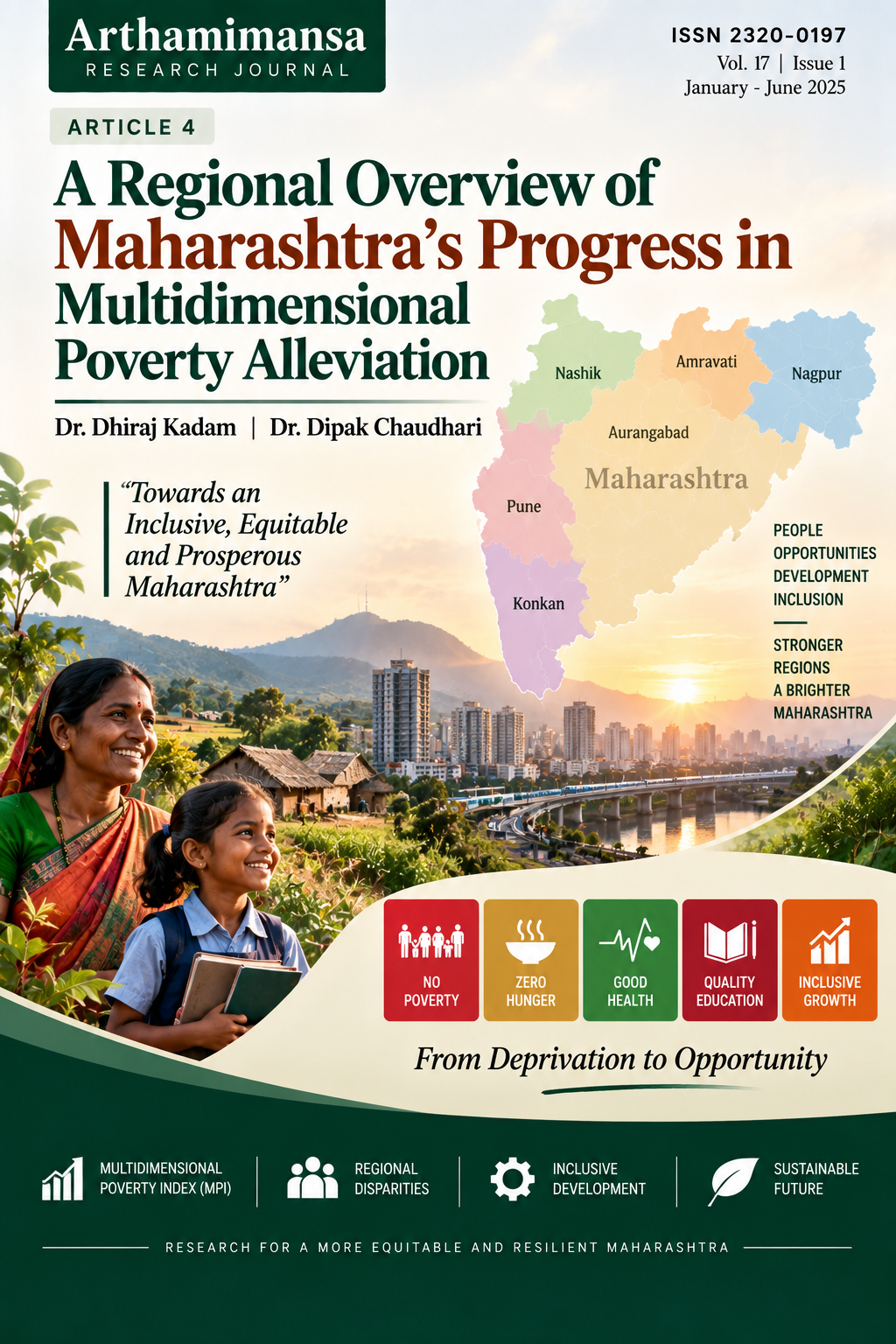
A Regional Overview of Maharashtra's Progress in Multidimensional Poverty Alleviation
Arthamimansa
Research Journal| Publication Type | Journal Article |
|---|---|
| Publication Year | 1905 |
| Author(s) | Dr. Dhiraj Kadam , Dr. Dipak Chaudhari |
| Journal Name | Arthamimansa Research Journal |
| Volume, Issue | 17 , 1 |
| Article Type | Research Paper |
⬇ Download PDF
Abstract
Although Maharashtra is considered an industrially advanced state, regional disparities and the challenge of multidimensional poverty remain significant. This research paper presents a regional analysis of the changes in the Multidimensional Poverty Index, Headcount Ratio, and Intensity of Poverty in Maharashtra during the period from 2015–16 (NFHS-4) to 2019–21 (NFHS-5). Utilizing data from NITI Aayog’s National MPI Progress Review (2023) and IIPS population projections (2021), it compares Maharashtra’s six administrative divisions: Konkan, Pune, Nashik, Aurangabad, Amravati, and Nagpur. The findings reveal that although Maharashtra’s overall MPI decreased by 49%, this decline is not uniform across all regions. Urban and industrial divisions like Pune and Nagpur achieved notable success in poverty reduction, while divisions such as Nashik, Konkan, and Amravati continue to show concerning levels of deprivation. The study underscores that poverty is not merely a matter of low income but is linked to multidimensional deprivations. Therefore, poverty eradication requires more than just statistical reduction—it demands region-specific, impact-driven, and socially inclusive policies. To achieve social justice, equal opportunity, and sustainable development in the state, there is a need to shift the policy focus from reducing the number of the poor to reducing the intensity of their poverty.