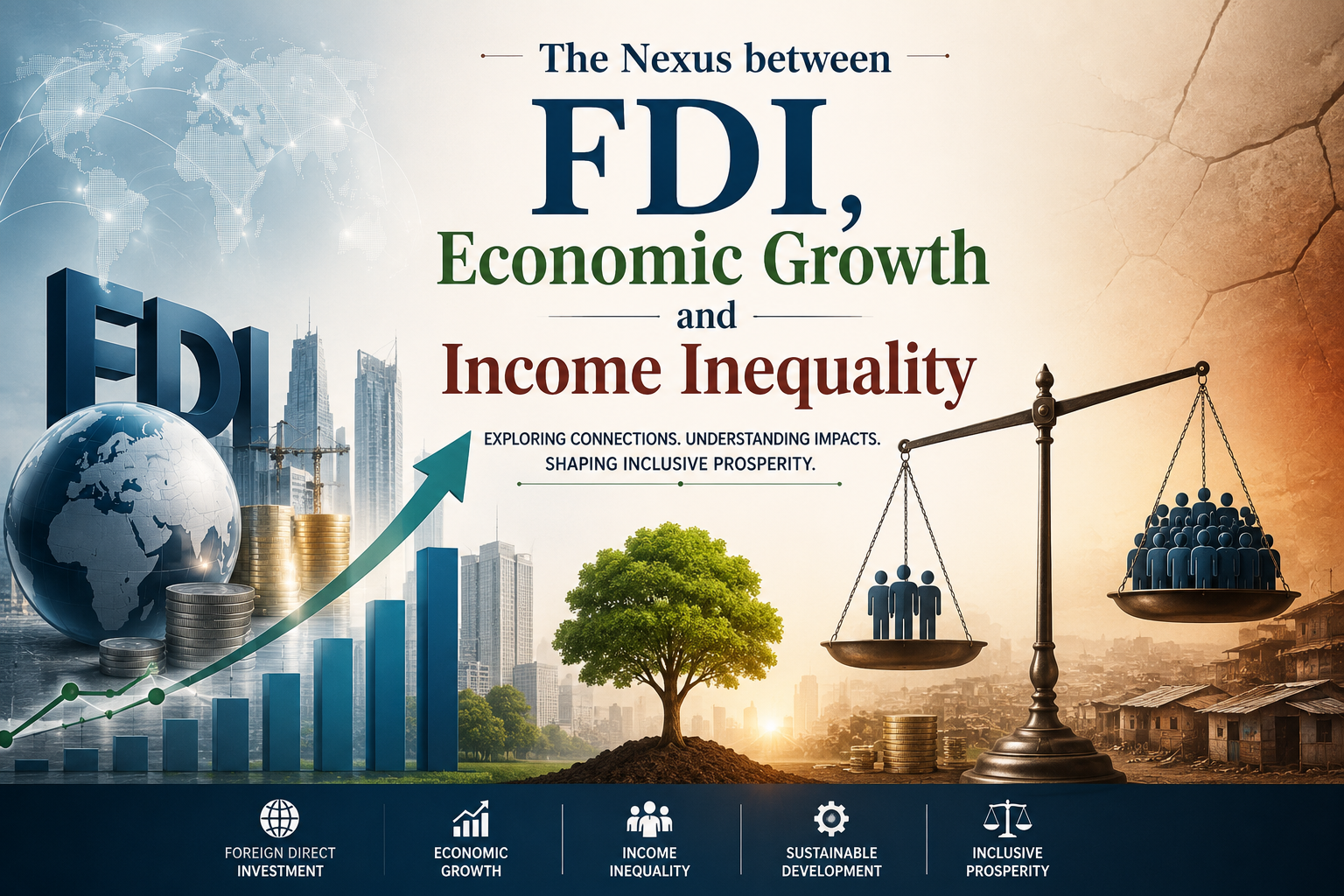
This study examines the nexus between economic growth (GDP per capita growth rate), Foreign Direct Investment (Net FDI inflow percent of GDP minus Net FDI outflow percent of GDP), and income inequality (Gini Index) in India over the period from 1991-2019 using the Autoregressive Distributed Lag (ARDL) model. The analysis demonstrates that while FDI and GDP growth accelerated rapidly, their impact on income inequality was trivial, with only a marginal decline observed. Foreign direct investment inflow is greater than outflow, indicating that India is attracting more foreign investment than it is investing abroad. However, no significant long-term relationship is found between FDI and income inequality. The findings suggest that strong economic growth and increased FDI do not automatically lead to reduced income inequality and that policymakers should adopt targeted measures to achieve inclusive growth.
Keywords: India, Income Inequality (Gini Index), Economic Growth, FDI, ARDL