
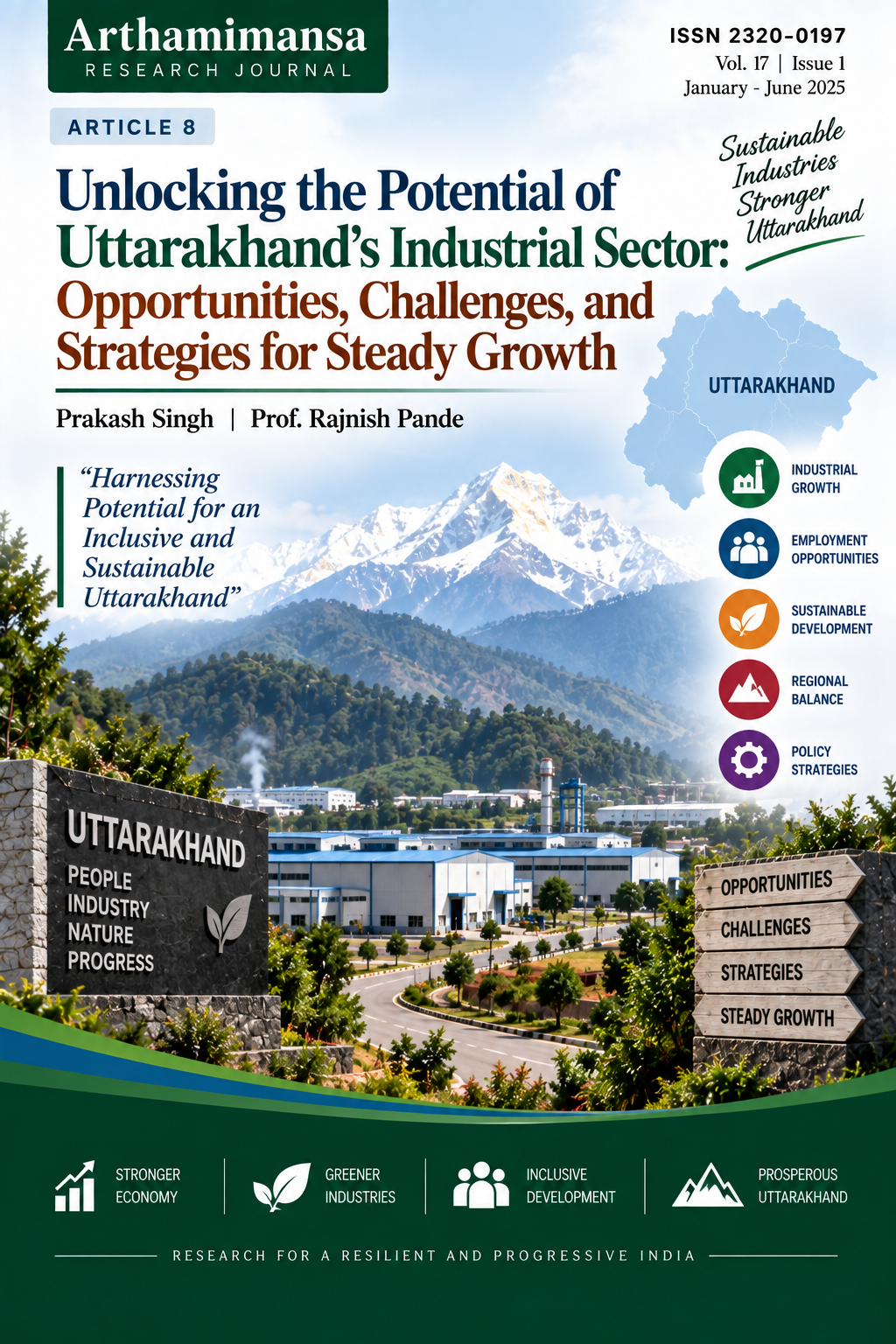
Unlocking the Potential of Uttarakhand’s Industrial Sector: Opportunities, Challenges, and Strategies for Steady Growth
Arthamimansa
Research Journal| Publication Type | Journal Article |
|---|---|
| Publication Year | 2025 |
| Author(s) | Prakash Singh , Prof. Rajnish Pande |
| Journal Name | Arthamimansa Research Journal |
| Volume, Issue | 17 , 1 |
| Article Type | Research Paper |
⬇ Download PDF
Abstract
This research paper investigates the industrial development of Uttarakhand, with particular emphasis on its economic prospects, challenges, and strategies to encourage sustainable industrial development. Since its establishment in 2000, the state’s industrial sector has experienced significant evolution, contributing approximately 36% to Uttarakhand’s Gross State Domestic Product (GSDP) by 2023. Crucial sectors such as pharmaceuticals, food processing, and micro, small, and medium enterprises (MSMEs), which employ over 60% of the workforce, have been pivotal drivers of this progress. Notwithstanding these accomplishments, several challenges endure, including geographical limitations stemming from the region’s mountainous terrain, environmental concerns, and the uneven distribution of industrial activity between urban and rural areas. Such challenges have resulted in considerable regional income disparities, with urban centres like Dehradun and Haridwar exhibiting markedly higher per capita incomes than mountainous districts. This study scrutinises the factors propelling industrial growth, assesses the obstacles hindering expansion, and suggests strategies for cultivating a more inclusive and environmentally sustainable industrial ecosystem. Principal recommendations encompass enhancing infrastructure, promoting green technologies, and aligning industrial policies with the state’s distinctive ecological context. The paper concludes that, through appropriate policy interventions and infrastructural investments, Uttarakhand can fully realise the potential of its industrial sector, thereby ensuring long-term economic resilience and mitigating regional disparities.